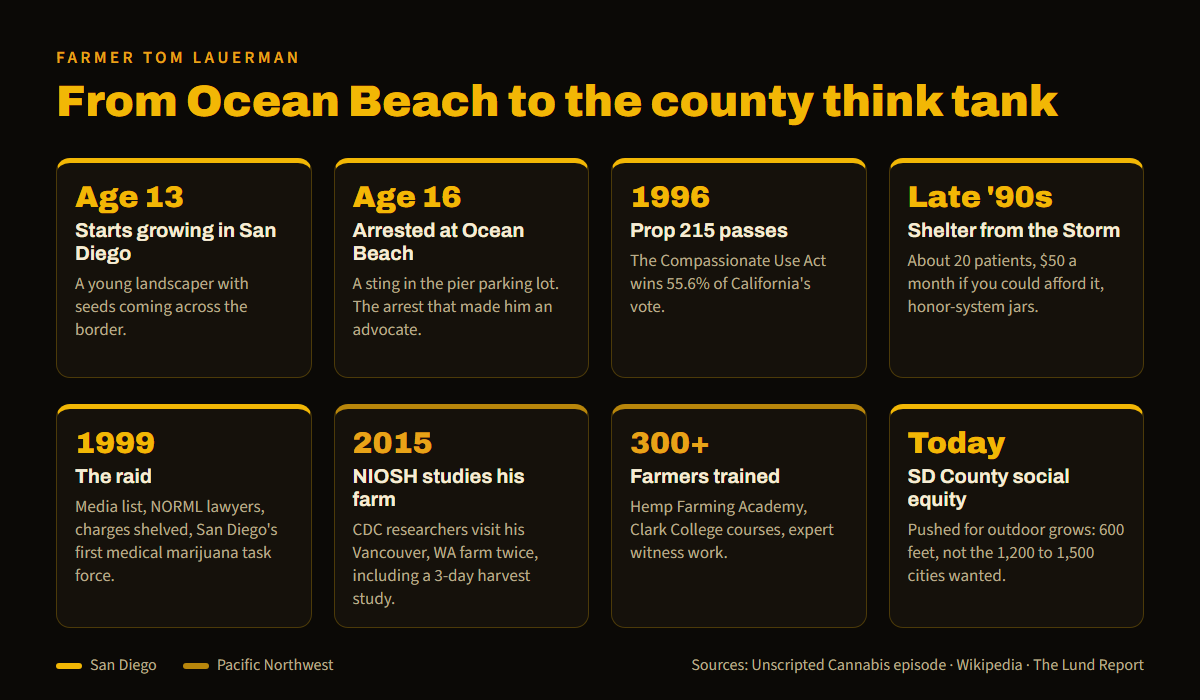
Under Prop 215, a San Diego medical cannabis collective could look like this: about 20 patients, a collective garden of 448 plants, and a monthly contribution of 50 dollars if you could afford it. Members came once a week and filled their own jar on the honor system. Nobody bought weed. That was Shelter from the Storm, and Farmer Tom Lauerman was its grower until police raided it in 1999.
Tom told the whole story to host Just J (Mr. Gudwudz) on Unscripted Cannabis. If you want to know what Prop 215 actually meant on the ground in San Diego, and why the 49% Collective is built the way it is, start here.
Listen: Farmer Tom Lauerman: From a 1999 Raid to Teaching the CDC About Cannabis (32 minutes)
Prop 215 made growing legal for patients, not selling
California voters passed Proposition 215, the Compassionate Use Act, on November 5, 1996, with 55.6% of the vote. It let patients with a doctor’s recommendation, and the people caring for them, grow and use cannabis. It did not create stores, licenses or a market. So the question every grower had in 1997 was simple: how do you supply 20 sick people without becoming a dealer?
Tom’s answer was a collective in the old sense of the word. He was the grower, alongside Steve McWilliams, whose family funded the operation. His wife, a nurse practitioner, was on site. The members covered, in Tom’s words, “every race creed color,” with cancer, AIDS, arthritis, glaucoma, PTSD and chronic pain among them. Here is how he described the money side:
“You bought a light if you could afford it. You paid 50 bucks a month if you could afford it. And then you came once a week and you filled up your jar or your baggie on the honor system.”
Farmer Tom Lauerman, Unscripted Cannabis
And the part that matters more than the money:
“It was a true collective model, you know, where we met together and we hung out together and we shared meals together and we supported each other.”
Farmer Tom Lauerman
You could not walk up with a recommendation and ask to buy. “That’s not the type of operation we are running,” Tom said. “We were more of a little community.”
San Diego was the hard place to do it
Tom grew up here. He started growing at 13, working as a landscaper, and says it plainly: “I’m from San Diego, so seeds were coming across the border and that got me into cannabis the first time.”
At 16 he was arrested in a sting in the Ocean Beach pier parking lot, just after surfing, for handing over a couple of Thai sticks to a man who kept hassling him. He said that arrest is what made him an advocate: “once you get arrested, the worst thing has happened and you really become an advocate for the plant at that point.”
Prop 215 was a statewide vote, but San Diego was not Humboldt or the Bay Area. Tom described the city then as “very conservative,” with police still kicking in the doors of patients who grew for a partner with AIDS or a family member with cancer. So Shelter from the Storm worked in the open. Members took four-inch plants to town hall meetings and explained, to a lot of rolled eyes, why the collective was safe.
The 1999 raid, and why the media list mattered
A dog started it. Tom’s dog nipped at the neighbor’s dog through the fence, the neighbor called the police, and in 1999 the grow room was raided.
The collective was ready because of a lesson from Brownie Mary, the San Francisco hospital volunteer arrested for baking cannabis for AIDS patients. When she was raided, the press was there. Tom’s takeaway:
“If the media is there, then the police have to play by the rules.”
Farmer Tom Lauerman
Everyone in the collective carried a media list. These were pager days, so Tom’s wife grabbed a cordless phone and started calling. Police told Tom he could go. He refused, because every member had a recommendation posted and the collective was following the law voters had passed.
Three things came out of the case:
- Free lawyers. National NORML provided attorneys because the case was so high profile.
- A stalled prosecution. On trial day, with another protest outside the courthouse, the charges were shelved rather than tried.
- A task force. “One of the results of our arrest was they started San Diego’s first medical marijuana task force.”
If you take one thing from this section, take Tom’s own summary: “we knew we were more powerful together as a group than each of us individually.”
What he taught the state of Washington and the CDC
After the case, Tom and his wife moved north, first to Williams, Oregon, then to a five-acre former nursery across the Columbia River in Washington. He grew for patients there and sold at Washington’s medical marijuana farmers markets, where the cannabis magazines came looking for stories.
When Washington lawmakers were deciding whether to ban concentrates outright, Tom and KOMO News reporter Matt Markovich staged live extraction demos, from a properly done open blast under a tarp outside to a closed-loop system inside. His point to the state was that people would keep blowing themselves up with cheap butane setups unless the process was regulated. His view of the job:
“Being an advocate’s more about being an educator.”
Farmer Tom Lauerman
That work led a union to put him in touch with federal health researchers. When Tom asked ten CDC staff on a call where their information came from, “They said, we’re getting it off YouTube.” So he offered his farm instead. In 2015, scientists from NIOSH, part of the CDC, visited his Vancouver, Washington farm twice, the second time for a three-day study of the fall harvest. According to The Lund Report (June 2, 2017), the resulting report found repetitive hand motions during trimming that could lead to musculoskeletal problems, and recommended job rotation and keeping scissors clean. Tom says the trimmers wore a sensor glove for the study and that the CDC still uses what it learned.
The fight is back in San Diego County now
Tom’s 1999 arrest is part of why he qualifies today as a San Diego County cannabis social equity applicant. He said he was invited into a think tank that helped shape the county’s rules, and pushed for outdoor cultivation when officials told him it could not be done. “Well, we got outdoor grow,” he said.
His case for outdoor rests on the county itself: it is huge, it is farm country, and the climate grows almost anything. “You can grow anything in San Diego. You can grow papayas to apples to peaches to like everything.” He also worked with the county on buffer distances for social equity cannabis, walking staff through the pros and cons. The county went with his recommendation, a 600-foot buffer, where different cities wanted 1,200 to 1,500 feet.
He is on the record about why he is still at it, 30-plus years in:
“We’re still gonna be here fighting for the plant and consuming the plant and doing the work that we were meant to do on this earth.”
Farmer Tom Lauerman
Why the 49% Collective starts from his model
Read Shelter from the Storm’s rules again and you will see the 49% Collective’s outline: pay what you can, show up in person, share food and knowledge, and keep control with the people doing the work. The collective is not a storefront either. It is a Home Garden Exchange, a Wednesday call, and a group of growers waiting on the county to move on licensing.
Farmer Tom co-leads that Wednesday call with Wade Olsen and Russell Palmer. You can read Farmer Tom’s bio on our About page, then see how membership in the 49% Collective is taking shape.
Want more of the story?
- Listen to the full episode on Unscripted Cannabis, or read the show’s recap of the episode.
- Find Tom at farmertom.com and his products at Farmer Tom Organics.
- Hear more from the host at Mr. Gudwudz.
Tom has already offered to come back for a part two. If you have a question for him about Prop 215, the raid, outdoor growing or the county’s social equity program, send it in and come to the call.